Quick Answer
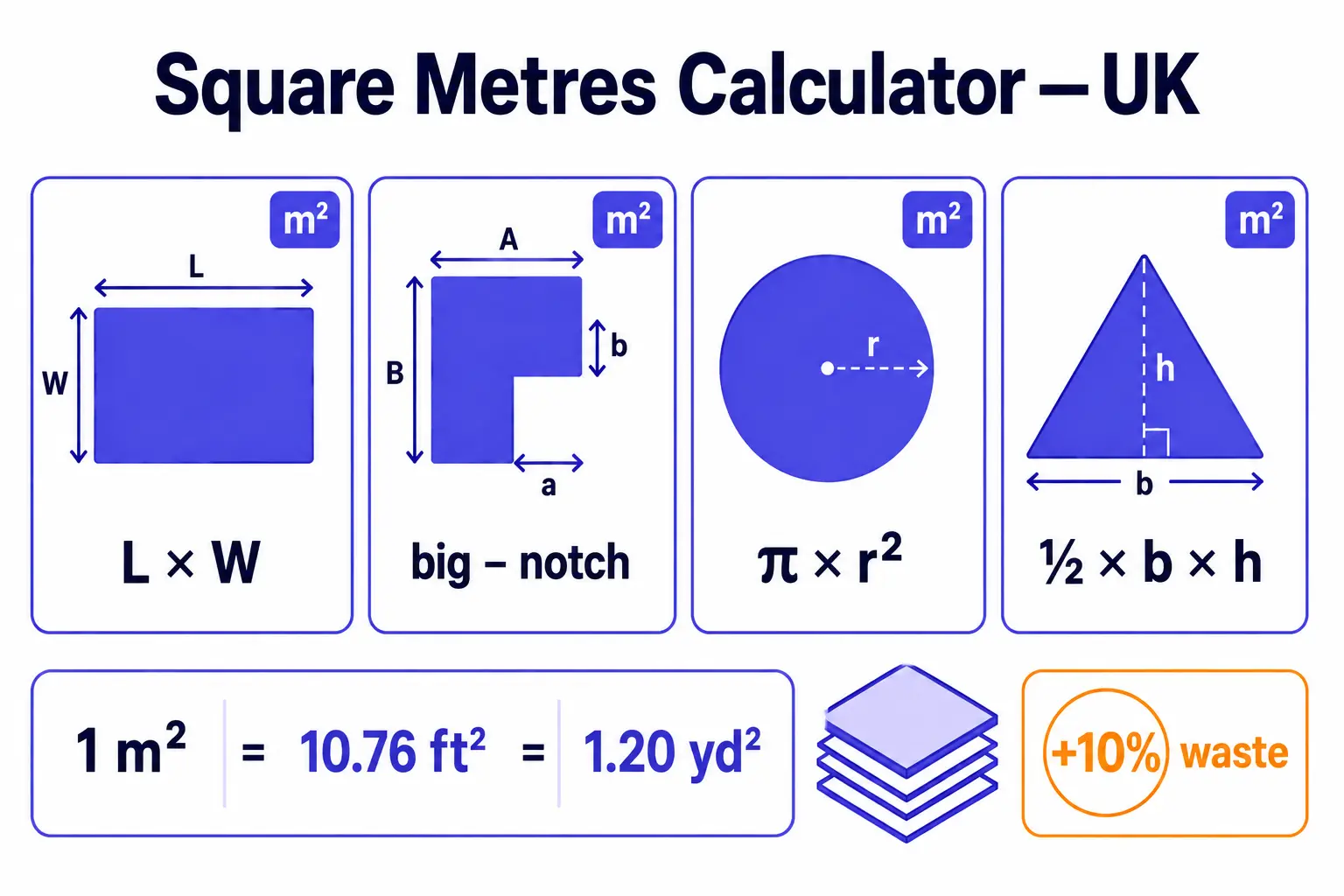
To find square metres, multiply length by width in metres — a 4 m × 3 m room is 12 m² (which is 129.17 ft² or 14.35 yd²). This square metre calculator does it for rectangles, L-shapes, circles and triangles, converts the result to square feet and yards, and works out how many packs of tiles, flooring or paint you need once you add a waste allowance.
How to Calculate Square Metres: Formula by Shape
A square metre (m²) is the area of a square one metre on each side. To work out the square metres of a room you multiply two lengths measured in metres. This calculator applies the right formula for the shape you pick, converts the answer to square feet and square yards, and in its second mode turns the area into the number of packs you actually have to buy.
L-shape: area = (overall length × overall width) − (cut-out length × cut-out width)
Circle: area = π × (diameter ÷ 2)²
Triangle: area = ½ × base × perpendicular height
Material: packs = round up [ area × (1 + waste%) ÷ coverage per pack ]
All the maths runs in metres, so you can type each measurement in the unit you actually have — metres, centimetres, millimetres, feet or inches — and the tool converts before it multiplies. Only the perimeter needs a shape that has one: a triangle’s perimeter needs all three sides, so the calculator reports it as not applicable rather than guessing.
How to Measure a Room for Square Metres
Most wrong answers come from the tape measure, not the arithmetic. Four habits fix nearly all of them.
- Measure at floor level, wall to wall
Skirting boards, radiator pipes and bowed plaster all make a room measure differently at waist height than at the floor. Take the tape along the skirting, and use the longest length and the longest width you find — rooms are rarely truly square, and ordering to the short measurement leaves you short of material.
- Work in one unit and let the tool convert
Write everything down in the unit you measured. If the tape reads 3,600 mm, enter 3600 and pick mm; do not round it to 3.5 m in your head. Every field has its own unit picker, so a room measured 12 ft by 3.4 m needs no conversion from you at all.
- Split awkward rooms into rectangles
A chimney breast, a bay window or a return turns one room into two or three simple shapes. Use the L-shape mode for a single notch, and for anything more complicated calculate each rectangle separately and add the areas together. Do not average a wall that steps.
- Decide what you are excluding, once
For flooring, most fitters measure the full rectangle and ignore the chimney breast, because the offcut is not reusable anyway. For paint, subtract windows and doors only if they are large. Whatever you choose, apply it to the whole job, or your waste allowance will be doing two different things in two rooms.
How to Use the Square Metre Calculator
- Pick a mode
Start on Room area to measure a space, or switch to Material & cost if you already know the area and want packs and price.
- Choose the shape and enter the dimensions
Rectangle for most rooms, L-shape for a chimney breast or return, circle for a round patio, triangle for a gable. Type each measurement and pick its unit (m, cm, mm, ft or in) from the box beside it.
- Read the area
You get the area in m², the same area in ft² and yd², a ready-made +10% figure for waste, and the perimeter for skirting or edging.
- Turn it into materials
In Material & cost, enter the area, choose a waste allowance (10% is standard), type how much one pack covers in m², and the price. The tool rounds packs up and totals the cost.
Square Metre Conversions: m², ft² and yd²
The conversions are exact, not approximations. A yard is defined as 0.9144 metre and a foot as 0.3048 metre, which makes a square yard exactly 0.83612736 m² — those figures are set out in the Schedule to the Units of Measurement Regulations 1995, and the same definitions appear in NIST Special Publication 811, Appendix B.8.
| Area | In ft² | In yd² | The same number as ft² → m² | As yd² → m² |
|---|---|---|---|---|
| 1 m² | 10.76 | 1.2 | 0.09 | 0.84 |
| 5 m² | 53.82 | 5.98 | 0.46 | 4.18 |
| 10 m² | 107.64 | 11.96 | 0.93 | 8.36 |
| 12 m² | 129.17 | 14.35 | 1.11 | 10.03 |
| 15 m² | 161.46 | 17.94 | 1.39 | 12.54 |
| 20 m² | 215.28 | 23.92 | 1.86 | 16.72 |
| 25 m² | 269.1 | 29.9 | 2.32 | 20.9 |
| 30 m² | 322.92 | 35.88 | 2.79 | 25.08 |
| 50 m² | 538.2 | 59.8 | 4.65 | 41.81 |
| 100 m² | 1,076.39 | 119.6 | 9.29 | 83.61 |
Read the last two columns as their own conversion: 100 ft² is 9.29 m² and 10 yd² is 8.36 m². Multiply m² by 10.7639 for square feet and by 1.19599 for square yards; divide by the same numbers to come back.
Common UK Room Sizes in Square Metres
These are typical sizes rather than any standard, but they are useful for sanity-checking a measurement before you order — if your “double bedroom” comes out at 30 m², something has gone wrong with the tape.
| Room | Typical size | Area | In ft² | Perimeter |
|---|---|---|---|---|
| Small single bedroom | 2.4 × 3 m | 7.2 m² | 77.5 | 10.8 m |
| Bathroom | 2.1 × 2.4 m | 5.04 m² | 54.25 | 9 m |
| Double bedroom | 3 × 3.6 m | 10.8 m² | 116.25 | 13.2 m |
| Kitchen | 3 × 4.2 m | 12.6 m² | 135.63 | 14.4 m |
| Single garage | 3 × 6 m | 18 m² | 193.75 | 18 m |
| Living room | 4.2 × 4.8 m | 20.16 m² | 217 | 18 m |
| Through lounge | 3.6 × 7.2 m | 25.92 m² | 279 | 21.6 m |
The perimeter column is there because it is the number you need for skirting, coving or edging strip, and it is the one people forget to work out while the tape is still in their hand. The calculator prints it alongside the area for every shape that has a defined perimeter.
Worked Examples: Room Area and Materials
Every figure below is exactly what the calculator prints — enter the same inputs to check.
| Shape & size | Area | In ft² | In yd² | Perimeter |
|---|---|---|---|---|
| Rectangle 4 m × 3 m | 12 m² | 129.17 | 14.35 | 14 m |
| Rectangle 5 m × 4 m | 20 m² | 215.28 | 23.92 | 18 m |
| L-shape 5 × 4 m − 2 × 1.5 m notch | 17 m² | 182.99 | 20.33 | 18 m |
| Circle, diameter 3 m | 7.07 m² | 76.09 | 8.45 | 9.42 m |
| Triangle base 4 m × height 3 m | 6 m² | 64.58 | 7.18 | n/a |
The L-shape row is worth following through, because it is the one people get wrong by hand: the whole rectangle is 5 × 4 = 20 m², the missing corner is 2 × 1.5 = 3 m², so the floor is 17 m² — but the perimeter stays 18 m, the same as the full rectangle, because the notch adds back exactly what it takes away.
| Job | Area + waste | Coverage | Packs | Cost |
|---|---|---|---|---|
| Floor tiles, 15 m² | +10% = 16.5 m² | 1.44 m²/box | 11.46 → 12 boxes | 12 × £24.99 = £299.88 |
| Laminate, 20 m² | +10% = 22 m² | 2.0 m²/pack | 11 → 11 packs | 11 × £19.99 = £219.89 |
| Bathroom tiles, 12 m² | +15% = 13.8 m² | 1.0 m²/box | 13.8 → 14 boxes | 14 × £30.00 = £420.00 |
| Paint, 40 m² wall × 2 coats = 80 m² | +0% = 80 m² | 60 m²/tin | 1.33 → 2 tins | 2 × £32.00 = £64.00 |
Notice the laminate row: 22 m² divided by 2.0 lands on exactly 11, so nothing is rounded up and there is no spare at all. That is the one case where it is worth buying an extra pack deliberately rather than trusting the arithmetic.
How Much Waste to Add, and How Many Packs to Buy
Never order the exact area — offcuts, breakages and future repairs all eat into it. UK trade guidance is to add about 10% for a standard straight lay, more for fiddly rooms and diagonal patterns. Whatever the waste, divide by the coverage on the box and always round up, because you cannot buy part of a pack.
| Layout / room | Waste to add |
|---|---|
| Simple straight lay, square room | 5–10% |
| Standard flooring or wall tiles | 10% |
| Bathrooms, bay windows, multiple rooms | 15% |
| Diagonal, herringbone or chevron | 15–20% |
If you would rather think in tiles than in boxes, the tile size sets how many cover a square metre. Tiles are still sold by the box, so the calculator works from box coverage — but this is the number to check the box against.
| Tile size | Area of one tile | Tiles per m² | Order per m² |
|---|---|---|---|
| 200 × 200 mm | 0.04 m² | 25 | 25 |
| 300 × 300 mm | 0.09 m² | 11.11 | 12 |
| 450 × 450 mm | 0.2 m² | 4.94 | 5 |
| 600 × 300 mm | 0.18 m² | 5.56 | 6 |
| 600 × 600 mm | 0.36 m² | 2.78 | 3 |
Carpet Meterage Is Not the Same as Floor Area
Carpet is the exception to everything above. It is not sold by the square metre off an unlimited sheet — it comes on a roll of fixed width, commonly 4 m or 5 m, and you buy a length off that roll. The width you do not use is still charged for. That is what a fitter means by meterage, and it is why a carpet quote is always more than the floor area.
| Room | Floor area | Cut off the roll | You pay for | Over floor area |
|---|---|---|---|---|
| 4.2 × 4.8 m | 20.16 m² | 5 m roll × 4.2 m | 21 m² | +4.2% |
| 3.6 × 4.2 m | 15.12 m² | 4 m roll × 4.2 m | 16.8 m² | +11.1% |
| 3 × 3.6 m | 10.8 m² | 4 m roll × 3 m | 12 m² | +11.1% |
| 2.4 × 3 m | 7.2 m² | 4 m roll × 2.4 m | 9.6 m² | +33.3% |
The small bedroom is the worst case: at 2.4 × 3 m you pay for 9.6 m² of a 4 m roll to cover 7.2 m² of floor, a third more than the area suggests, because the 3 m side runs across a 4 m roll and the leftover 1 m strip — 2.4 m² of it — is still on the bill. The lesson is to check both room dimensions against the roll widths a shop stocks before comparing prices per square metre — a 5 m roll can be cheaper overall than a 4 m roll at the same headline price. To use this calculator for carpet, put the roll area you are actually buying into Material & cost rather than the floor area, and set waste to 0 so you are not adding an allowance twice. Flooring sold by the linear metre off a roll works the same way; our square feet to linear feet calculator converts between the two.