Quick Answer
Slope percentage equals rise divided by run times 100 — a 6-inch rise over a 10-foot run is 5%, and degrees = atan(percent ÷ 100), so 5% sits at 2.86°. A 2% drainage slope falls about 1/4 inch per foot (6 inches over 25 feet), and a 100% slope is a 45° angle, not a vertical face.
Slope Percentage Formula
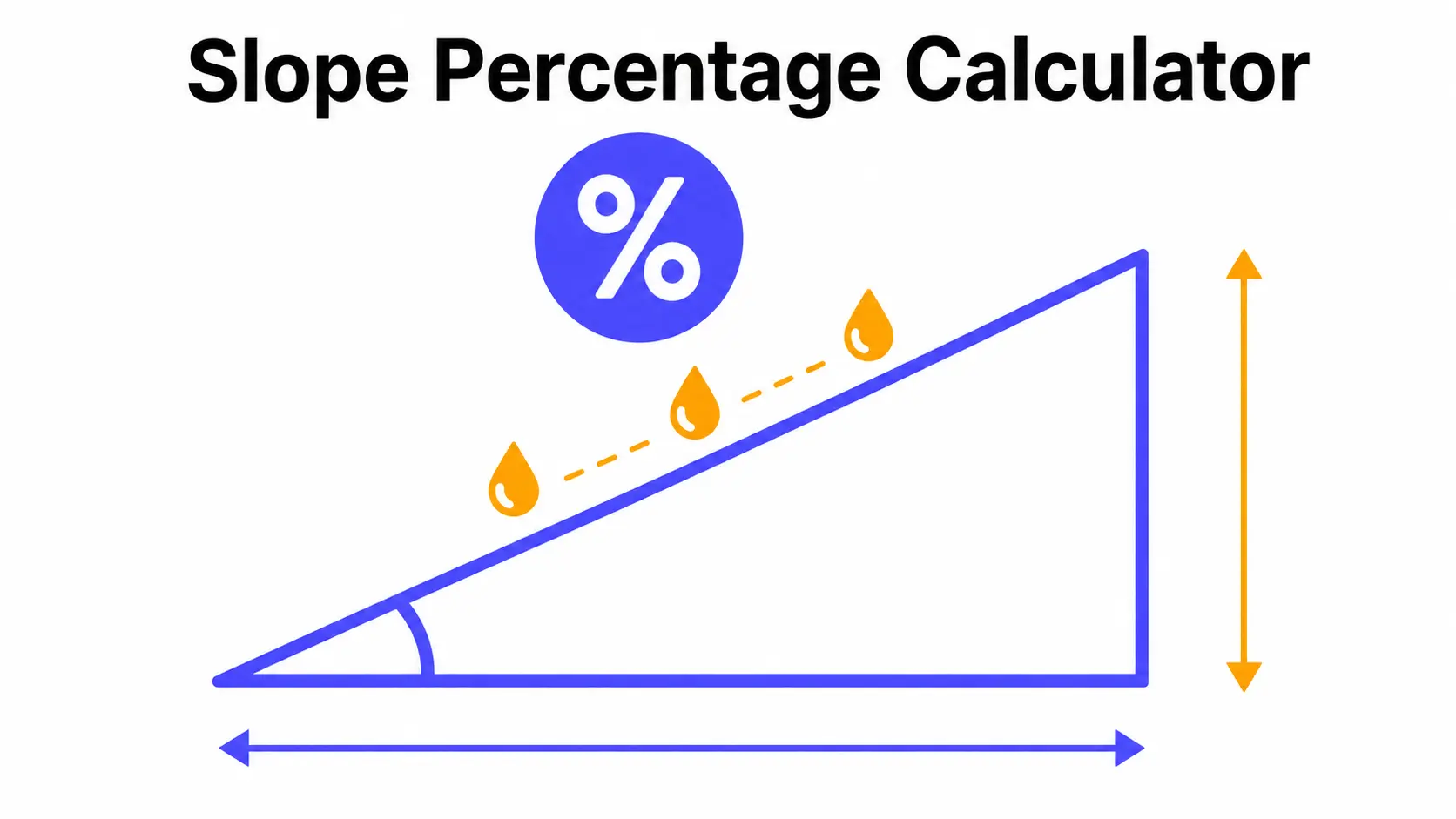
The rise is the vertical change; the run is the horizontal distance measured flat, not along the sloped surface (USGS method). Because percent slope is the tangent of the angle × 100, a 100% slope is exactly 45°.
The same incline can be written four ways, and every trade uses a different one. This calculator returns all four at once, from whichever one you have:
| Notation | Example | Who uses it | Convert from percent |
|---|---|---|---|
| Percent grade | 5% | Roads (MUTCD hill signs), site grading | — |
| Angle in degrees | 2.86° | Surveying, CAD, roof geometry | atan(% ÷ 100) |
| Ratio (1 in N) | 1 in 20 | Ramps and accessibility codes | N = 100 ÷ % |
| Inches per foot | 0.6 in/ft | Plumbing and drainage | % × 0.12 |
Slope Percent to Degrees Conversion Chart
The bolded rows are the values building codes are actually written around: 1/8 and 1/4 inch per foot pipe slopes (IPC) and the 1:12 ADA ramp limit — which drops exactly 1 inch per foot.
| Slope % | Angle | Ratio | Drop per foot | Drop over 10 ft |
|---|---|---|---|---|
| 0.5% | 0.29° | 1 in 200 | 0.06 in | 0.6 in |
| 1% | 0.57° | 1 in 100 | 0.12 in | 1.2 in |
| 1.04% (1/8 in/ft) | 0.60° | 1 in 96 | 0.125 in | 1.25 in |
| 2% | 1.15° | 1 in 50 | 0.24 in | 2.4 in |
| 2.08% (1/4 in/ft) | 1.19° | 1 in 48 | 0.25 in | 2.5 in |
| 3% | 1.72° | 1 in 33.3 | 0.36 in | 3.6 in |
| 4% | 2.29° | 1 in 25 | 0.48 in | 4.8 in |
| 5% | 2.86° | 1 in 20 | 0.6 in | 6 in |
| 6% | 3.43° | 1 in 16.7 | 0.72 in | 7.2 in |
| 8% | 4.57° | 1 in 12.5 | 0.96 in | 9.6 in |
| 8.33% (ADA 1:12) | 4.76° | 1 in 12 | 1.00 in | 10 in |
| 10% | 5.71° | 1 in 10 | 1.2 in | 12 in |
| 12.5% | 7.13° | 1 in 8 | 1.5 in | 15 in |
| 15% | 8.53° | 1 in 6.7 | 1.8 in | 18 in |
| 20% | 11.31° | 1 in 5 | 2.4 in | 24 in |
| 25% | 14.04° | 1 in 4 | 3 in | 30 in |
| 33.33% | 18.43° | 1 in 3 | 4 in | 40 in |
| 50% | 26.57° | 1 in 2 | 6 in | 60 in |
| 100% | 45° | 1 in 1 | 12 in | 120 in |
How to Use the Slope Percentage Calculator
- Pick what you already have.
Choose Rise & run if you measured two distances, Percent slope if you have a grade like 2%, or Angle (degrees) if you have an incline angle.
- Enter the value with its unit.
Mixed units are fine — rise in inches, run in feet. The pickers convert everything through the exact foot (0.3048 m).
- Set the run length.
In Rise & run mode this is the run itself. In the other modes it is the distance the total-drop read-out is computed over — set it to your patio or pipe length to plan a fall.
- Read all four notations at once.
The panel shows percent, degrees, the 1-in-N ratio, the drop per foot and the total drop over your run — no separate conversions needed.
Slope Percentage Examples
Every row is computed exactly the way the calculator does it: slope = rise ÷ run, degrees = atan(slope), drop = slope × run. Laying out steps instead of a ramp? Rise and run are the same idea per tread — the stair stringer calculator handles that layout.
| Scenario | Inputs | Slope % | Angle | Drop / rise |
|---|---|---|---|---|
| Deck sloped for rain run-off | 6 in rise over a 10 ft run | 5% | 2.86° | 6 in (given) |
| Patio at the IRC impervious-surface minimum | 2% over a 25 ft slab | 2% | 1.15° | 0.5 ft = 6 in |
| ADA ramp at the legal limit | 30 in rise over a 30 ft run | 8.33% | 4.76° | 30 in — the ADA’s maximum rise for a single run |
| 4-in sewer lateral at the IPC minimum | 1/8 in/ft over 40 ft | 1.04% | 0.60° | 5 in |
| Posted 10% hill, one mile long | 10% over 5,280 ft | 10% | 5.71° | 528 ft |
The 2% Rule: Drainage and Pipe Slopes in Percent
Most “what slope do I need” searches are drainage questions, and the codes answer them in three different notations at once. The IRC requires the ground to fall 6 inches within the first 10 feet away from a foundation — that is a 5% grade — and impervious surfaces like patios and walks within 10 feet of the building to slope at least 2% away (IRC R401.3). Drain pipes are specified in inches per foot instead (IPC Table 704.1):
| Pipe size (IPC Table 704.1) | Minimum slope | As percent | As ratio |
|---|---|---|---|
| 2½ in and smaller | 1/4 in per ft | 2.08% | 1 in 48 |
| 3 in to 6 in | 1/8 in per ft | 1.04% | 1 in 96 |
| 8 in and larger | 1/16 in per ft | 0.52% | 1 in 192 |
Percent Slope vs Degrees: the 45° = 100% Trap
Percent slope is the tangent of the angle × 100, and tangent is not linear. Doubling the percent does not double the angle, and the scale blows up as slopes get steep: 45° is 100%, 60° is 173.2%, 80° is 567%, and at 90° the run is zero, so percent slope is undefined — there is no such thing as a “200% vertical wall”. Going the other way, shallow slopes are nearly linear: below about 10% you can estimate degrees ≈ percent × 0.573.
Converting angles in the other direction — including degrees as a share of a full circle for pie charts, not just slopes — is covered by the degree to percentage calculator.